Choosing the Right Training Aircraft in 2026: What Actually Matters
Selecting a flight school in 2026 is no longer just about location or price—it is about the platform.
As the industry pivots toward advanced automation, sustainable propulsion, and integrated digital ecosystems, the aircraft you log your first 40 hours in will dictate how prepared you are for the flight decks of the future.
The global pilot shortage, estimated to peak at around 24,000 pilots in 2026 (per Oliver Wyman analysis), has forced training institutions to move toward “outcome-based” training. This means using aircraft that don’t just teach you how to fly, but how to manage complex systems. Whether you are a prospective student or a program lead, understanding the shift toward “Glass-First” and eco-conscious trainers is essential for long-term career success.
When comparing modern training programs, it’s worth exploring how different flight schools structure their fleets and technology.
📖 Table of Contents
- Key Takeaways: The 2026 Training Landscape
- Cirrus SR Series G7+: The New Safety Standard
- Pipistrel: The Eco-Friendly, Low-Cost Alternative
- The Tech Inside: Why Avionics Outweigh Airframes
- 2026 FAA Regulatory Updates
- Frequently Asked Questions (FAQ)
🛩️ Key Takeaways: The 2026 Training Landscape
- The Safety Benchmark: The Cirrus SR Series G7+ now standardizes Safe Return™ Emergency Autoland, recently receiving certification from the FAA, EASA, and UK CAA for use in the SR20 and SR22 lines.
- Sustainability & ROI: Pipistrel has secured Transport Canada validation for the all-electric Velis Electro, allowing schools to operate with zero local emissions and noise levels of just 60 dBa.
- Avionics Standard: The Garmin G1000 NXi has become a widely adopted standard across many training programs, with institutions like ATP refreshing fleets to ensure students learn modern logic from day one.
- Regulatory Streamlining: Section 806 of the FAA Reauthorization Act has simplified high-performance piston endorsements, removing significant application friction for experienced experimental pilots.
1. Cirrus SR Series G7+ Overview
For flight schools positioning themselves at the premium end of the market, the Cirrus SR Series G7+ is widely considered one of the leading platforms. With Cirrus recently celebrating its 11,000th SR Series delivery, the platform has become a foundational element of modern flight instruction.
In testing and early operator feedback on the G7+ Perspective Touch+ avionics, the primary benefit for students isn’t just the automation—it’s the reduction in “cognitive load.” By automating database updates and providing Runway Occupancy Awareness, the G7+ allows learners to focus on airmanship rather than cockpit chores.
The “Safe Return” Evolution
The headline for 2026 is the global certification of the Safe Return™ Emergency Autoland system. While once a novelty, it is now standard equipment on all G7+ models. This system can autonomously navigate to the nearest suitable airport and land without pilot intervention.
While some purists argue this “softens” pilot skills, flight school owners see a different picture: lower insurance risk. While “premiums dropping” is a strong claim, some insurers are beginning to offer more favorable terms or specialized coverage for fleets equipped with whole-airframe parachutes (CAPS) and autoland systems, as they significantly reduce the likelihood of a total-loss accident during solo operations.
Connectivity for the Modern Pilot
In 2026, the G7+ cabin is a fully integrated digital hub:
- High-Power USB-C Integration: Dual 60W ports in the front and 100W ports in the rear are specifically designed to power high-demand devices like Starlink mobile kits.
- 4-Blade Evolution: The SR22 now offers a 4-blade composite propeller upgrade, which provides smoother engine operation and a distinct profile on the ramp.
👉 Top
2. Eco-Friendly & Cost-Effective Trainers: The Pipistrel Line
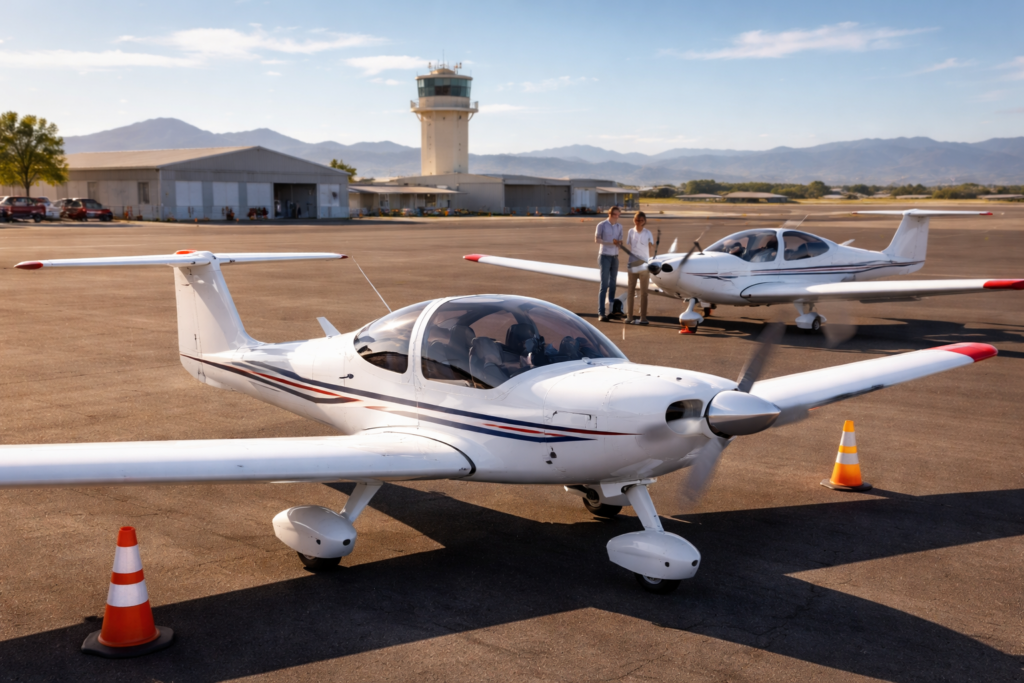
While Cirrus owns the high-performance tier, Textron Aviation’s Pipistrel line is winning the battle for affordability. As the industry moves away from leaded fuels via the EAGLE Initiative, Pipistrel provides a proactive solution for schools looking to future-proof their operations.
The North American Expansion
A major milestone for early 2026 is Transport Canada’s validation of type certificates for the Pipistrel Explorer, Velis Club, and the all-electric Velis Electro.
The Velis Electro is particularly attractive for schools located near noise-sensitive residential areas. Operating at just 60 dBa during takeoff, it is nearly silent from the ground compared to a legacy Cessna 150. This “stealth” capability allows schools to extend training hours into the early morning or late evening without violating local noise ordinances.
The Economics of Modern Flight
Schools like Pegasus Flight School in Texas have reported that Pipistrel aircraft offer a massive advantage in operating costs.
- Fuel Efficiency: The Rotax-powered Pipistrel models burn significantly less fuel than traditional Lycoming engines, with some operators reporting significantly reduced hourly energy costs (often cited in the 40–60% range depending on use case).
- Maintenance: With fewer moving parts in the electric motor (Velis Electro), maintenance intervals are simplified, keeping aircraft in the air rather than in the hangar.
👉 Top
The Tech Inside: Why Avionics Outweigh Airframes
In 2026, the specific brand of the airplane matters less than the suite inside the panel. The industry has converged on the Garmin G1000 NXi as a widely adopted standard across many training programs for “ab initio” (from the beginning) training.
The “NXi” Advantage
The G1000 NXi’s dual-core processor eliminates the map-rendering lag common in older units, which can be especially important when a student is hand-flying a missed approach in busy airspace.
- SurfaceWatch: This technology provides visual and aural cues to help prevent runway incursions—a leading cause of student incidents.
- Standardization: Major programs, including ATP Flight School, have standardized their fleets on the NXi. This means a student moving from a single-engine Skyhawk to a multi-engine Seminole encounters the exact same logic, helping reduce transition time between aircraft types.
Many of these systems are now standard across leading training organisations.
👉 Top
2026 FAA Regulatory Updates: Navigating the New Rules
The FAA has introduced several key changes stemming from the 2024 Reauthorization Act that are being implemented through 2026.
1. High-Performance Experimental Endorsements (Section 806)
The FAA has reestablished the authorization for all makes and models of certain experimental piston aircraft. Pilots who hold at least three AEA authorizations can now operate additional experimental aircraft via a logbook endorsement from an instructor, bypassing the previously required FAA application process.
2. Helicopter Training (SFAR 73)
The revision to Special Federal Aviation Regulation (SFAR) 73 has clarified flight-review requirements for rotary-wing schools. By removing low-gravity maneuvers from the syllabus, the FAA is aligning training with modern Airworthiness Directives to prevent mast-bumping accidents in light helicopters like the Robinson R22.
Finding the Right Program in the 2026 Landscape
When browsing the AviatorFinds Directory, look beyond the paint job. A lower-cost flight school using older analog trainers may end up costing more in the long run because of the steep learning curve you’ll face during jet transitions.
In 2026, the most competitive flight schools are those that invest in:
- Modern Fleet Mix: High-performance Cirrus and cost-effective Pipistrel.
- Avionics Consistency: Standardizing on G1000 NXi or G3X platforms.
- Safety Automation: Proactively using technologies like Autoland and Envelope Protection.
👉 Explore our Top Flight Schools Directory to compare fleet tech and start your journey today.
👉 Top
Frequently Asked Questions (FAQ)
What is the newest Cirrus trainer aircraft for 2026?
The 2026 SR Series G7+ is the current release, featuring the Safe Return™ Emergency Autoland system and cloud-based database updates via Cirrus IQ PRO Advanced™.
Are electric trainer aircraft certified for use in Canada?
Yes. Transport Canada has validated the type certificates for the Pipistrel Velis Electro, the world’s first certified all-electric trainer.
Why is Garmin G1000 NXi training considered “career-ready”?
The G1000 NXi uses similar logic and automation principles found in modern commercial flight decks, allowing students to develop professional cockpit management skills from their first flight hour.
About the Author: This guide was curated by the AviatorFinds Editorial Team, featuring insights from CFIs and aviation tech specialists with over 30 years of combined experience in general aviation fleet management.
Further Reading
- AOPA – Pilot training resources
- UK Civil Aviation Authority – Flight training guidance
- EASA – Pilot licensing standards
- Federal Aviation Administration (FAA) – Flight training and safety guidance
👉 Top
Recommended aviation gear
Please choose display type!